martes, 6 de diciembre de 2016

Summer holidays

After finishing my classes and exams, like every year, I'm going to look for a job for the summer.
In my free time, I'll probably spend it resting, playing, or going out with my boyfriend. In addition to finishing reading a long list of books that I have pending.
Maybe even, if given the chance, I could spend some days at my sister's house in Viña del Mar.
If all goes well, next summer I could go on vacation. I would like to know the north of the country, since the farthest I have come is to La Serena.
It would be fun to know Atacama, Antofagasta, Tarapaca and Arica.
Each of these places, as well as their surroundings, shows off its natural sceneries, its history and a rich culture that dates back to Pre-Columbian times.

The national parks and monuments of Lauca, Isluga and the Surire Salt Deposit shelter a wide biological diversity in this zone.

In addition to the valuable archeological heritage, such as the geoglyphs of Mount Pintado and the pucarás of Quitor and Lasana, this area dazzles visitors with the fantastic topography of the Valley of the Moon and the Atacama Desert, El Tatio geysers and the hot springs. A synthesis of the encounter between the pagan customs and the catholic practice is the Virgen del Carmen Festival in the village of Tirana, 72 kilometers to the East of Iquique.

The exploitation of guano and saltpeter in the past was superseded by a significant mining activity, with the copper mines of Chuquicamata (Calama), and commercial development represented by the ports and the tax-free area of Iquique.
So I will work hard this summer to be able to travel and to know all these places next year.
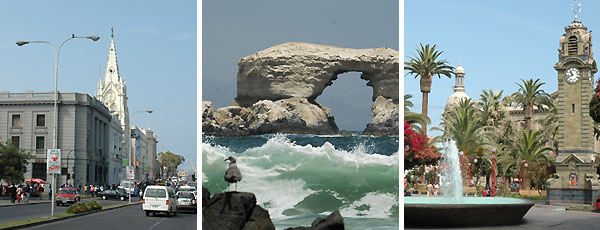
Antofagasta -Photos: Jorge González

Addiction From coffee and tea to drugs of abuse

In my family, there is no abuse of illegal drugs, at least as far as I know.
My sister likes to smoke cigarettes, but only 1 or 2 in the day.
On the other hand, one of my aunts is addicted to cigarettes, sometimes smokes 20 or more cigarettes in a single day. It is a vice that has for many years, but to date has not presented the health problems that are associated with excessive consumption of cigarettes, such as lung cancer.
You can see that it is an addiction because when she can not smoke for whatever reason, she despairs and tries to find a way to smoke.
Although I do not like her to smoke that much, the truth is that after so many years it is almost impossible for her to quit smoking and I do not think there is much that we can do.
A personal experience with cigarettes occurred to me when I was 13 or 14 years old.
Like most teenagers, I go through the stage of revealing myself against my parents and doing things I really did not need to do.
At this stage I tried the cigarette, just because I wanted to look older and more mature, I did not like it, but many of my friends from that time did it and to be with them I did it too.
When my mother found out about this, I obviously punished myself for a long time and forbade me to continue seeing that group of friends. I currently do not smoke, I really do not like it (I tried a couple of times when I was older), but more important than that is my health: I have a problem in the lower part of my spine, according to my doctor, if I smoke, he will have to operate me to place a prosthesis due to bone wear.

I do not think smoking is good, but after all it's a legal drug and if you're old, it's your decision whether you do it or not.

Post Graduate studies

Once I finish the course I would like to become one of the magister who teaches in the faculty of chemical and pharmaceutical sciences (our faculty): the master in Food, mention Management, Quality and Food Safety.
For me it would be a very good way to complement everything that you should know when you graduate from the food engineering career. Then perhaps if possible, I would look for some postgraduate course outside the country and the possibility of permanent work abroad.
It is a course that lasts between three and six semesters, and although it is a little expensive, I think it is important to continue studying and improving as a professional.
This course has the main objective of forming graduates with training in food, aimed at professionals who require a greater depth and management of scientific, technological and management knowledge, per the development, innovation and technology needs for the country.
For this magister, it is necessary to approve a total of 120 credits. The curricular activities correspond to 52 credits that are distributed in: 40 credits of compulsory curricular activities and 12 credits of elective curricular activities. The Project of Degree corresponds to 68 credits that are distributed in: 8 credits like Preliminary of Degree, 30 credits like Project of Degree I and 30 credits like Project of Degree II.

It would be a challenge that I would like to take once I finish the career.

Your Future Job...

A few years ago, while I was on vacation in La Serena with my family, we decided to visit Capel's plant located in Vicuña.
It was great to be able to see the whole process through which the grape goes and I thought that working in that area of the food industry could be very interesting.
It would be a job that would keep me constantly in the outdoors, since it is important to check the conditions under which the grapes will be used to produce piscos and wines of good quality.
I think the only problem I would have with a job of this type would be to leave Santiago. I have lived here all my life and I am not sure that I would adapt to a more rural place like Vicuña or its surroundings. But if there was the possibility of traveling between Santiago and La Serena, I would do it as many times as necessary to do my job.
I do not know for sure what the wage would be for a job of this type, but I think that regardless of how much you can earn in your job, it is priceless to do something that you love or passionate about.

I do not know what I'll end up working on in a few years, I just hope it makes me happy.

miércoles, 19 de octubre de 2016

Digressing about music: songs, dances, melodies, groups, films...


Speaking of music, I have no particular taste.
I usually listen to the radio, or some random list on youtube, the only kind of music I cannot tolerate for nothing is the reggaeton.
But a band I like since I was twelve years old, is Placebo, I have many memories when I listen again his songs.
For those who have never heard of them, Placebo is an English alternative rock band, formed in London in 1992 by singer-guitarist Brian Molko and guitarist-bassist Stefan Olsdal. The band was soon joined by drummer Robert Schultzberg, who was replaced in 1996 by Steve Hewitt. Hewitt parted ways with the band in 2007 due to personal and musical differences and was replaced the following year by Steve Forrest, who left the band in 2015 to pursue his own musical career.
To date, they have released seven studio albums, all of which have reached the top 20 in the United Kingdom, and have sold around 11 million records worldwide
They have come to Chile on several occasions, and I was lucky enough to attend one of his concerts on March 30, 2007.
That was my first concert. It was difficult to get permission because my mom thinks I was too young to go alone. Finally she said yes and my dad bought me ticket as a really advanced birthday gift, because my birthday is in July.
To date, every time I remember the concert I turn to thrill as that day.

 Running Up That Hill - concert in Chile


miércoles, 12 de octubre de 2016

Our Amazing Human Body

The human eye:


The human eye is an organ located in the front of the head and each eyeball has a size between 15.5 and 18 mm at birth and reaches almost 14-15 years adult size ranging between 23 and 24, 5 mm.
The human eye is an organ that reacts to light and has several purposes. As a sense organ, the mammalian eye allows vision. Rod and cone cells in the retina allow conscious light perception and vision including color differentiation and the perception of depth. The human eye can distinguish about 10 million colors and is possibly capable of detecting a single photon.
For such a small part of the body, the eye has a very complex structure and therefore there is more of a specialist in the medical area devoted to their care and maintenance. They are
There are many diseases, disorders, and age-related changes that may affect the eyes and surrounding structures.
Common eye problems include:
1.-Refractive errors:
Myopia, or nearsightedness: Clear vision of close but blurry at a distance
Farsightedness or hyperopia: clear distance vision, but blurred close
Presbyopia: Inability to focus closely result of aging
Astigmatism: Focus problems caused by the cornea
2-.Cataracts: when the lens becomes cloudy
3-.Glaucoma optic nerve injury by increased eye pressure
4-.Retinal diseases: problems with the layer of light-sensitive tissue located in the back of the eye
5-.Macular Degeneration: disease that destroys the central focus of the vision
6-.Eye problems associated with diabetes

7-.Conjunctivitis: an infection of the conjunctiva

And finally, to maintain good vision and good eye care, we have to:
Read/watch tv good light and at a suitable distance.
Avoid looking directly at the sun and intense light sources.
but above all the most important it is to consult the doctor annually.

martes, 9 de agosto de 2016

From the invisible to the visible world and back...

Functional nanofood


In the near future, a hamburger that reduces cholesterol will not be impossible. Nanoscience, defined by some as the restructuring of food atomic or molecular level oriented to obtaining nanoingredients with better properties, is a reality in which both government and private initiative invest in research and development.
There is increasing scientific evidence supporting the hypothesis that certain foods as well as some of its components have beneficial physical and psychological effects, thanks to the contribution of basic nutrients.
Among other applications, they have been developed pharmacopoeia products by nanoencapsulation, which is the inclusion of active ingredients such as vitamins and / or enzymes, biodegradable nanocapsules in which release their contents upon contact with certain cells or juices / organic secretions.
These days the application of this technology would facilitate the potential development of products with regular fat levels between 25.0% and 35.0%, redesigning with content lower than 1.0% and maintaining its characteristics of texture and palatibility at the level of acceptance of the regular product.
Reduce global obesity levels, create foods that provide more calories in sectors such as Africa where there is a high level of malnutrition, or even to combat common diseases nowadays. The truth is that we can expect promising development in this field of research.

I chose this topic because I found it more interesting than other topics that include nanotechnology. Besides, has real importance in the career of Food Engineering.
I just learned about this topic right now because it was what was asked on this week's blog.